
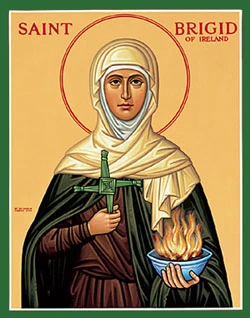
St. Brigid or the Goddess Brigit
Imbolg falls on the first week of February. The Celtic calendar had two principal festivals, Samhain in November and Bealtaine in May. Separating these two main festivals were two lesser celebrations, Imbolg in February and Lugnasad in August. Of all of these seasonal festivals we know the least about Imbolg. It is believed to mark the beginning of lactation in ewes and it corresponds with the Feast of St. Bridget in the Christian Calendar.
It seems most likely that the feast was a celebration of fertility which coincided with the end of winter and the beginning of spring and new life.
Would the real Brigit please stand up?
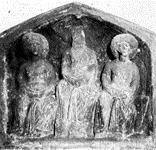
It is also believed in some quarters that St Bridget was a Christianised version of a Celtic fertility god, Brigit, who was the daughter of one of the principal Celtic gods, the Dagda. She is supposed to have had particular attributes in the fields of learning and healing. Brigit had two sisters, both of whom were also called Brigit, apparently relating to the Celtic tendency for deities to appear in triplicate.
Triad Goddesses appear in numerous Romano-British sculptures in Britain, where it may indicate that the Romans adopted some of the local deities as their own.
A traditional St. Bridget's Cross
Brigit’s name can also be detected in numerous place names on continental Europe, suggesting that she was part of ritual practice across the Celtic world. The Brigantes, a Celtic tribe in Britain, worshipped the goddess Briganti, who some authors also link with Brigit.
So if your kids are making their St. Bridget’s Cross this week, spare a thought for your pre-Christian ancestors and what they might have been getting up to at this time of the year!